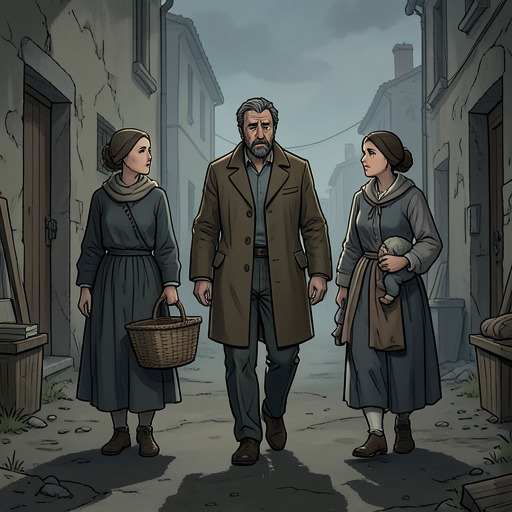
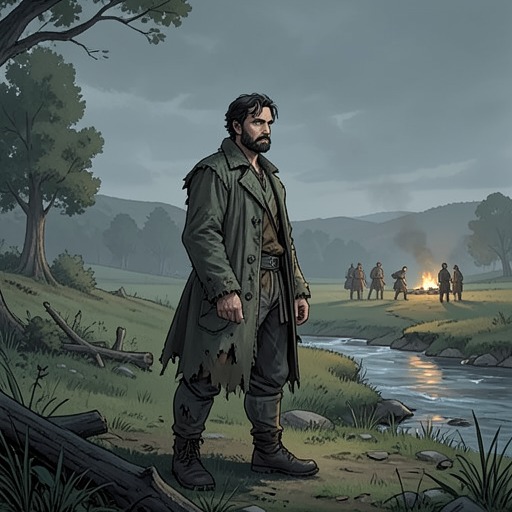
Csongor and Balga’s master-servant relationship
Csongor és TündeCsongor and Balga’s master-servant relationship joins a social hierarchy to a shared journey: Balga is introduced as a field laborer who later becomes Csongor’s servant, but his service is marked not by reluctance but by wholehearted consent. When Csongor turns toward Tündérhon in pursuit of Tünde, Balga accepts the invitation to serve and travel with him, making the relationship a practical alliance within the larger quest.
Identity and Beginning
Balga’s place in the relationship is stated plainly: he is a field laborer, later Csongor’s servant. The description gives the bond a social foundation before the play shows it operating in dialogue. Csongor occupies the position of master; Balga enters the story from a working, ordinary world, and the change in his status places him beside a hero moving through supernatural lands and trials.
That hierarchy does not make Balga’s role merely functional. His presence gives Csongor a companion for the road, while the servant’s own speech and choices show that he participates willingly in the bond. The relationship therefore brings together unequal social positions and a shared direction of travel: Csongor leads, but Balga chooses to follow.
A Bond Renewed at the Crossroads
At the Hármas út, a place explicitly identified as the setting of an act, Csongor addresses Balga and reminds him that Ilma, once known as Böske, has become Ilma and has gone to Tündérhon. The exchange connects the men’s service relationship to Balga’s personal attachment: the news concerns the woman he has followed, even as the scene turns toward Csongor’s own continuing pursuit.
Csongor then makes the relationship explicit by asking Balga to serve him. Balga accepts with emphatic joy, not hesitation or bargaining. The moment renews the bond by consent: Csongor names the service, and Balga answers that he will undertake it gladly. His response makes loyalty visible as an action rather than an assumption attached to his lower status.
Shared Purpose and Unequal Roles
The renewed service immediately acquires a destination. Csongor says they should go toward Tündérhon, where the beautiful Tünde shines. The paired statements—Balga’s acceptance of service and Csongor’s declaration of their route—turn the master-servant bond into a traveling partnership directed toward the search for Tünde. Csongor determines the objective; Balga supplies the willing companionship that makes the journey shared.
This arrangement keeps the hierarchy intact while giving it an intimate, mobile form. Balga does not take over Csongor’s quest, and the evidence does not erase the distinction between master and servant. Instead, the relationship gains force from the combination: one character sets the course, while the other freely commits himself to it. In a play structured around departures and movement between places, that commitment gives Csongor a companion at the threshold of the road.
Dramatic Significance
The relationship also links two romantic pursuits without making them identical. Csongor’s stated destination is Tündérhon and Tünde; the preceding news tells Balga that Ilma has already gone there. Balga’s service to Csongor consequently carries him toward a place associated with his own beloved as well as his master’s aim. The scene brings their purposes into proximity while preserving their different positions and attachments.
Balga’s eager answer is the clearest measure of the bond in the supplied scenes. Service could be presented as an imposed condition, but here Csongor’s request receives an enthusiastic acceptance, and the pair depart with a common direction. The relationship thus operates as both a social relation and a structure of companionship: Csongor remains the master and leader, while Balga’s chosen loyalty helps turn solitary pursuit into a journey undertaken together.